One morning, I was waiting for a ride-hailing car at the entrance to Shuiliugou. As I looked down at the car’s route on my phone, I felt someone gently touch me on the left.
Startled, I instinctively moved away. I turned and saw an elderly woman.
“Excuse me,” she asked softly. “How do I get to the bus stop for Hospital 266?”
Hospital 266 was the old name for what is now Hospital 981. Hearing that familiar name, I thought she was probably local.
Having seen so many negative stories online involving older people, I was still a little wary and looked her over.
Black cloth shoes, gray trousers, a pale red top, an old cloth bag over her shoulder. Everything was clean and tidy, though washed almost white with age. White fibers showed through the red fabric of her top, leaving it a faint pink.
Her hair was loosely gathered, but not untidy. I noticed that her eyes were cloudy and pale. She seemed unable to see the way ahead clearly.
Much of my wariness faded.
But I genuinely did not know which stop she needed. It was the day of our group’s quarterly meeting, and I had plenty to prepare at the office that morning.
“Huoshenmiao is just ahead…” I said gently.
She interrupted: “The traffic booth at Huoshenmiao?”
I paused. In my memory, that traffic booth belonged to my primary school days.
“No, the bronze statue of the Kangxi Emperor up ahead. Turn right at the junction. There’s a large bus stop not far along. Go that way and ask again.”
“Thank you. May you prosper and live a long life. May you live to a hundred.”
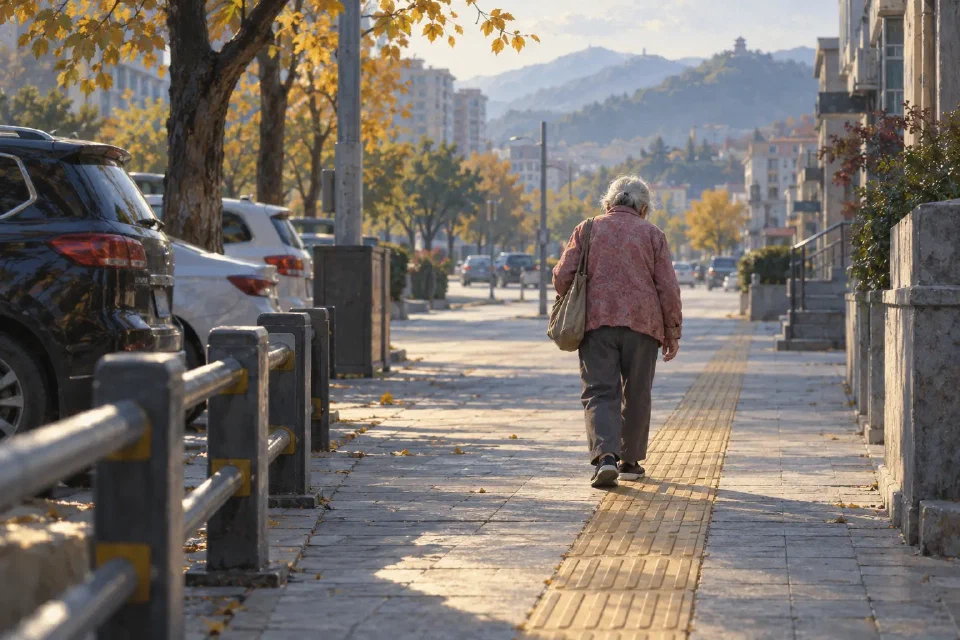
AI-generated illustration, not a photograph of the event.
My heart ached.
Looking at this elderly woman asking for directions alone, I thought of my family, and of my future self. We all grow old.
She moved slowly forward, testing each step, apparently still murmuring something. I watched from behind, full of conflicting feelings.
Ahead stood a parking barrier on the pavement. She was getting closer and was about to walk into it. Cars were also driving along the pavement beside her, at no small speed.
I could not bear to watch. I hurried after her and guided her away from the barrier and cars. She seemed unsure what to do, struggling to follow as I helped her move. After some maneuvering, I finally brought her close to the tactile path.
“Thank you. May you prosper and live a long life. May you live to a hundred.”
She was navigating today’s streets, one tentative step at a time, using memories from decades ago. Her repeated wish was simple and solemn. Perhaps it was the most generous expression of thanks she could think of.
“You’re welcome. Take your time.”
I walked back, turning every few steps to look. She was still moving slowly away, testing each step.
At the office, I washed my hands repeatedly. I am rather particular about cleanliness; washing after physical contact is a habit. Even afterward, the image of her tentative steps stayed in my mind.
I had not taken her to the bus stop or made sure which bus she eventually boarded. I had only helped her past one obstacle immediately in front of her.
A little help, within my ability.
Yet I could not put it out of my mind.
We usually walk too quickly to notice the parking spaces on pavements, the barriers in the way, or whether a tactile path continues unobstructed. Or the older people who walk a little slowly across a road, only to be hurried along by repeated car horns.
I often pass these very places. Only after taking those few steps beside her did I understand how hard even a short stretch of pavement could be.
When we talk about an aging society, we eventually have to face these concrete questions: Where can someone wait for a bus? How can they get past an obstacle? Can they cross before the light changes? How many such moments does someone who cannot see clearly encounter on a single trip outside?
I also remembered the provisions for people with disabilities that I noticed while studying for my master’s degree in Japan. Their purpose now felt more concrete: to let someone with poor sight or limited mobility go out alone with a little less worry.
There was still much to do that morning. Yet her words, “May you live to a hundred,” kept ringing in my ears.
I hope that when we grow old, when we walk slowly and cannot see clearly, we too will be able to make our way along the street without fear.